



The quality of your decisions depends not just on your reasoning ability but the state you are in when you make them. The same leader who is sharp, curious and generous on a good morning can become rigid, cutting or strangely absent by 4pm on a bad day. Nothing about their capability has changed. Their nervous system has.
Most leadership development focuses on what you do: strategy, communication, influence. This piece is about the physiological state you are operating from, and how to manage it deliberately. The idea at its center is simple and practical. It is called the Window of Tolerance.
The Window of Tolerance
The Window of Tolerance is the zone of arousal in which you can take in information, think clearly and respond rather than react. The term was coined by the psychiatrist Dan Siegel (1999) and later developed in body-based approaches to regulation (Ogden, Minton & Pain, 2006). It describes a band, not a single point: inside it, you can feel pressure, frustration or excitement and still stay in charge of your behavior.
Think of your nervous system as having three broad settings:
- Above the window (hyperarousal): too much activation. Your system is braced for a fight or ready to run.
- Inside the window: alert, engaged and flexible. You can hold complexity, listen to disagreement and make judgement calls.
- Below the window (hypoarousal): too little activation. Your system has gone into energy-saving or shutdown mode.
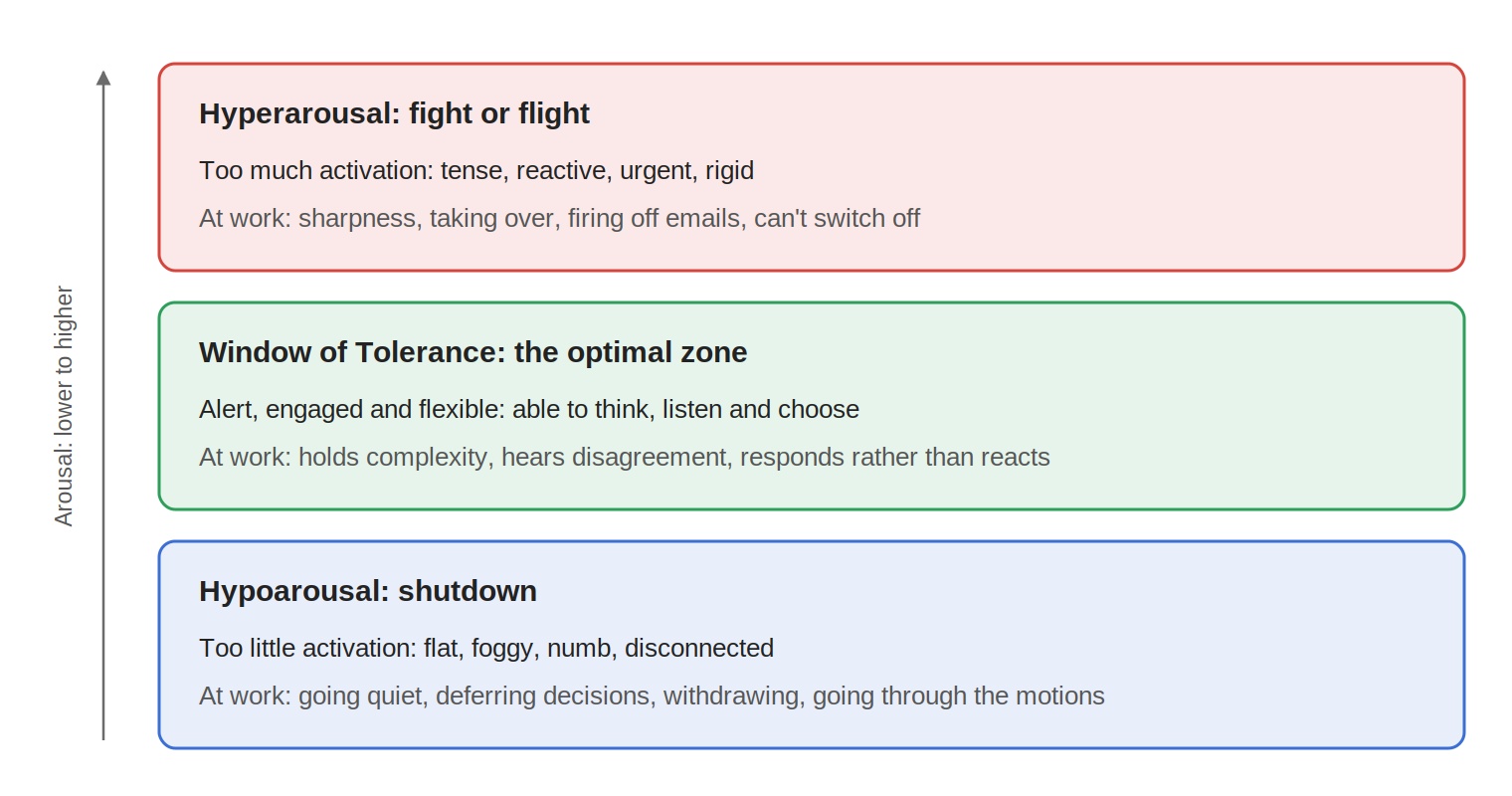
Being inside the window is not the same as being calm. A leader in their window can be intensely focused during a crisis, or feel real anger in a tough conversation. The difference is that the feeling informs the situation rather than hijacking it. This fits with research from neuroscience showing that the brain's thinking center, the prefrontal cortex, works best at moderate levels of stress and is impaired when cortisol levels are too low or too high (Arnsten, 2015).
Two things matter for leaders. The first is noticing early when you are drifting towards the edge of your window. The second is how wide your window is. A wide window means you can absorb a lot of pressure before your thinking degrades. A narrow one means relatively small triggers can tip you out. The good news is that the width is not fixed.
Above the window: when the alarm takes over
Hyperarousal is your threat system in charge. Heart rate rises, attention narrows onto the danger, and the parts of the brain responsible for nuance, perspective and empathy get less say (Arnsten, 2009). This is useful if you need to dodge a car. It is much less useful in a board meeting.
In leaders, hyperarousal rarely looks like panic. More often it looks like:
- Sharpness, impatience or sarcasm, especially with people you see as slow or careless
- Taking over: micromanaging, rewriting others' work, jumping in before they have finished
- Certainty that hardens into rigidity; difficulty hearing "no" or a different view
- Firing off emails or messages you later wish you had held
- Scanning for what could go wrong, and treating ambiguity as danger
- Difficulty switching off: replaying conversations at night, working late to feel safe
In the body, watch for a tight jaw or shoulders, shallow breathing, heat in the face or chest, a raised or faster voice, and a sense of urgency that everything must be resolved now. The cost is rarely one bad moment. It is the pattern. Teams learn to manage their leader rather than the work. They stop bringing bad news early.
Below the window: when the system powers down
Hypoarousal is the other way out of the window, and it is easier to miss because it's a quieter response. When pressure has been too much for too long, or when fighting back feels pointless, the nervous system can dial down. Energy drops, feelings flatten and engagement fades.
In leaders, it tends to show up as:
- Going quiet or vague in meetings where you would normally contribute
- Procrastinating on decisions, or deferring to whoever speaks loudest
- Feeling foggy, heavy or oddly detached, as if watching yourself from a distance
- Withdrawing from people: cancelling one-to-ones, hiding behind email
- Going through the motions; a sense that it does not really matter
Many high-threat leaders swing between the two. After a period of running hot, they crash: a flat weekend, a strange numbness after a big win, or exhaustion that sleep does not fix. That crash is not laziness. It is the system trying to recover from running above the window for too long (McEwen, 1998).
Why some leaders' alarms run hot
Your threat system was calibrated early. If you grew up in an environment that was unpredictable, demanding or unsafe, your nervous system learned a sensible lesson: stay alert, anticipate problems, and act fast. That calibration tends to persist into adulthood, long after the original environment has gone (McLaughlin, Sheridan & Lambert, 2014).
This is not a flaw. For many successful leaders, that early vigilance became a core strength. It is the source of their ability to spot risks others miss, read a room in seconds, work relentlessly and stay composed when others panic. It very likely helped them get where they are. Researchers increasingly describe these as capabilities adapted to challenging early environments, rather than simply deficits (Ellis et al., 2017).
The challenge is that a system tuned for danger does not easily tell the difference between a real threat and a challenging email. It reacts to a board member's raised eyebrow with the same physiology it once needed for something more serious. The result is a window that is effectively narrower: less headroom before the alarm goes off, and more time spent near the edge.
The goal is not to remove the vigilance. It is to keep the strength and add a dial: to be able to notice when the alarm has fired, and to bring yourself back into the window by choice.
Getting back into the window in the moment
You can't think your way out of a physiological state; you have to work through the body first. The sequence that works best is notice, name, then shift.
Notice. Learn your early signals. Most people only recognize they were out of the window afterwards. The skill is to catch it earlier: the jaw tightening, the urge to interrupt, the fog descending.
Name it. Silently labelling the state ("I'm getting activated" or "I'm checking out") puts a little distance between you and it. It moves you from being in the reaction to observing it. Brain-imaging research shows that putting feelings into words reduces activity in the brain's threat-detection center, the amygdala (Lieberman et al., 2007).
Shift. Then choose a technique that matches the direction you have drifted.
If you are above the window (bring it down):
- Lengthen the exhale. Breathe in normally, then breathe out slowly for longer than the in-breath. A double inhale through the nose followed by a long exhale (sometimes called a physiological sigh) is quick and invisible in a meeting. In a controlled study, five minutes a day of exhale-focused breathing improved mood and reduced physiological arousal more than mindfulness meditation did (Balban et al., 2023).
- Slow down on purpose. Speak more slowly, lower your voice slightly, and put a pause before you answer.
- Buy time. "Let me think about that and come back to you this afternoon" is a leadership skill, not a weakness. Draft the email; send it tomorrow.
- Feel your feet. Press them into the floor and notice the chair supporting you. It pulls attention out of the story and into the present.
If you are below the window (bring it up):
- Move. Stand up, walk, take the stairs, shake out your arms.
- Sharpen the senses. Cold water on the wrists, a strong mint, or looking around and naming five things you can see.
- Make one small decision. Action restarts engagement. Choose the next single step and do it.
- Connect. A short, real conversation with someone you trust brings most people back online faster than anything done alone.
Widening the window over time
In-the-moment techniques get you back in. Widening the window means you leave it less often in the first place. That comes from a few steady habits rather than any single technique.
- Know your triggers. Keep a simple note for two weeks: when did you leave the window, which way, and what happened just before? Patterns emerge quickly: certain people, certain meeting types, being questioned in public, feeling out of control.
- Protect the basics. Sleep, food, movement and time away from screens are not optional extras. A tired nervous system has a narrower window (Goldstein & Walker, 2014).
- Build recovery into the day. Put five-minute gaps between back-to-back meetings. The window narrows through accumulation, not just single events (McEwen, 1998; Sonnentag & Fritz, 2007).
- Practice when it is easy. A few minutes of slow breathing or quiet attention each day trains the skill so it is available under pressure. You would not learn to swim in a storm.
- Plan for known pressure points. Before a difficult conversation, decide how you want to show up, and one signal that will tell you to pause.
- Recover deliberately after a spike. After a hot moment, discharge it: a walk, a conversation, some exercise. Then reflect on it once you are back in the window, not while you are still out of it.
Over months, leaders who do this consistently report the same shift: the alarm still fires, but it fires later, quieter, and they come back faster.
Questions to reflect on
When were you last clearly above your window at work? What did others see, and what did it cost?
When were you last below it? How did you notice, if you did?
What are your three earliest physical signals that you are starting to leave the window?
Which situations or people narrow your window most reliably?
What is the one in-the-moment technique you will try this week, and in which meeting?
What does your vigilance give you that you want to keep?
References
Arnsten, A. F. T. (2009). Stress signalling pathways that impair prefrontal cortex structure and function. Nature Reviews Neuroscience, 10(6), 410–422.
Arnsten, A. F. T. (2015). Stress weakens prefrontal networks: Molecular insults to higher cognition. Nature Neuroscience, 18(10), 1376–1385.
Balban, M. Y., Neri, E., Kogon, M. M., Weed, L., Nouriani, B., Jo, B., Holl, G., Zeitzer, J. M., Spiegel, D., & Huberman, A. D. (2023). Brief structured respiration practices enhance mood and reduce physiological arousal. Cell Reports Medicine, 4(1), 100895.
Ellis, B. J., Bianchi, J., Griskevicius, V., & Frankenhuis, W. E. (2017). Beyond risk and protective factors: An adaptation-based approach to resilience. Perspectives on Psychological Science, 12(4), 561–587.
Goldstein, A. N., & Walker, M. P. (2014). The role of sleep in emotional brain function. Annual Review of Clinical Psychology, 10, 679–708.
Lieberman, M. D., Eisenberger, N. I., Crockett, M. J., Tom, S. M., Pfeifer, J. H., & Way, B. M. (2007). Putting feelings into words: Affect labeling disrupts amygdala activity in response to affective stimuli. Psychological Science, 18(5), 421–428.
McEwen, B. S. (1998). Protective and damaging effects of stress mediators. New England Journal of Medicine, 338(3), 171–179.
McLaughlin, K. A., Sheridan, M. A., & Lambert, H. K. (2014). Childhood adversity and neural development: Deprivation and threat as distinct dimensions of early experience. Neuroscience & Biobehavioral Reviews, 47, 578–591.
Ogden, P., Minton, K., & Pain, C. (2006). Trauma and the body: A sensorimotor approach to psychotherapy. W. W. Norton.
Siegel, D. J. (1999). The developing mind: Toward a neurobiology of interpersonal experience. Guilford Press.
Sonnentag, S., & Fritz, C. (2007). The Recovery Experience Questionnaire: Development and validation of a measure for assessing recuperation and unwinding from work. Journal of Occupational Health

